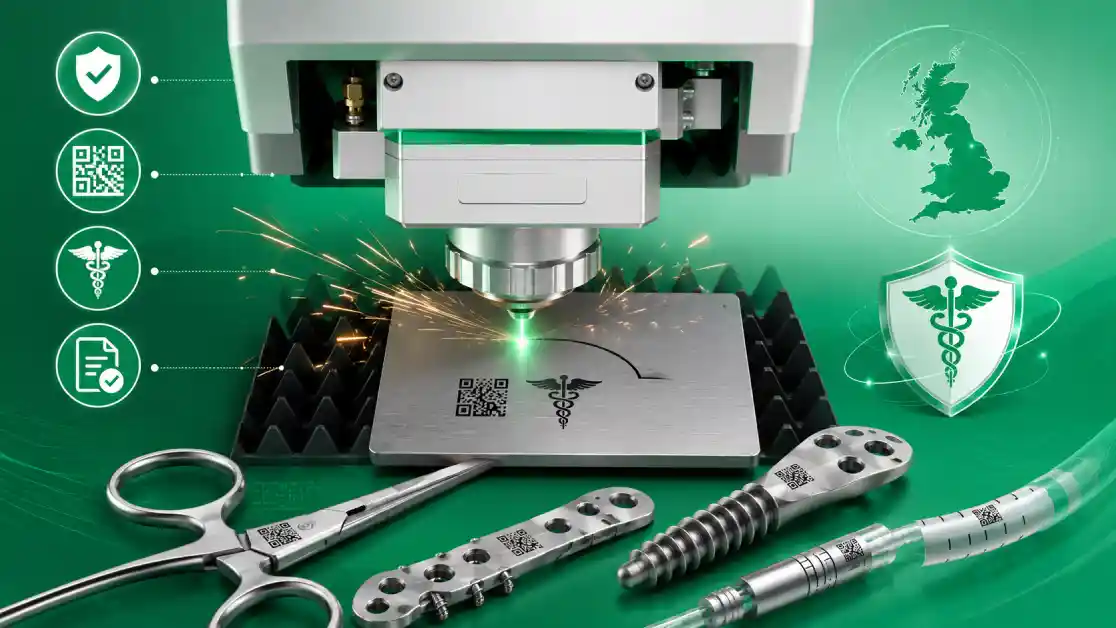
In the medical manufacturing sector, effective laser marking serves a far greater purpose than simply adding identification details to a device. It supports product traceability, patient safety, regulatory compliance, and long-term device identification throughout the product lifecycle. Whether a reusable surgical instrument undergoes repeated sterilisation cycles or an implant remains in service for years, the marking must remain clear, durable, and readable.
Across the UK and Europe, regulatory expectations surrounding medical device identification have become increasingly rigorous. Manufacturers are expected to create markings that remain permanent, corrosion-resistant, biocompatible, and capable of withstanding demanding medical environments throughout a device’s intended lifespan.
To meet these requirements, manufacturers increasingly rely on advanced laser processing technologies. Modern laser cutting machines and marking systems are commonly used to create permanent UDI codes, Data Matrix identifiers, and traceability markings on medical-grade materials while supporting quality and compliance objectives.
Understanding how these technologies operate, and how they align with UK MDR, EU MDR, FDA, and ISO 13485 requirements, is essential for organisations involved in the design and manufacture of medical devices.
Why Laser Marking Matters in Medical Device Manufacturing
Medical environments are particularly demanding when it comes to product identification. Devices are routinely exposed to sterilisation procedures, cleaning chemicals, abrasion, and continuous handling throughout their operational life.
Traditional identification methods such as labels, ink printing, and surface-applied markings often struggle to maintain legibility under these conditions. Over time, markings may fade, detach, or become difficult to scan, creating challenges for traceability and quality control.
Laser marking addresses these limitations by producing permanent marks directly on the material surface. Key advantages include:
- Permanent identification
- Precise UDI and Data Matrix code creation
- Resistance to sterilisation processes
- No need for inks, solvents, or adhesives
- Compatibility with medical-grade metals and polymers
- Improved lifecycle traceability
For many reusable surgical instruments and implantable devices, direct part marking has become a practical necessity rather than a simple manufacturing preference.
Regulatory Frameworks Governing Medical Device Marking
UK MDR and EU MDR Requirements
Medical device regulations in the United Kingdom and European Union place significant emphasis on product traceability. Manufacturers are expected to maintain identification systems that allow devices to be tracked throughout their entire lifecycle.
These requirements are particularly relevant for:
- Surgical instruments
- Implantable devices
- Reusable medical tools
- Orthopaedic implants
- High-risk medical components
Unique Device Identification systems have become a central component of compliance within both markets.
FDA UDI Requirements
Manufacturers supplying medical devices to the United States must also comply with the FDA’s Unique Device Identification framework.
A typical UDI may include:
- Device Identifier (DI)
- Production Identifier (PI)
- Batch or lot number
- Serial number
- Manufacturing date
- Expiry date
To satisfy regulatory requirements, these identifiers must remain both machine-readable and human-readable throughout the intended lifespan of the device.
ISO 13485 and Process Validation
ISO 13485 requires manufacturers to validate production processes that influence product quality, including marking operations.
It is important to understand that a laser system itself is not automatically FDA-approved or ISO-certified for medical use. Instead, manufacturers validate the specific process used for a particular material and application.
Changes involving:
- Laser parameters
- Software settings
- Equipment configuration
- Surface finishes
- Material specifications
may require revalidation to ensure ongoing compliance.
Common Laser Marking Processes Used in Medical Manufacturing
Different applications require different marking techniques. The most suitable process depends on factors such as material composition, corrosion resistance requirements, and sterilisation demands.
Laser Annealing
Suitable For
- Stainless steel surgical instruments
- Titanium implants
- Corrosion-sensitive components
Laser annealing creates a dark oxide layer beneath the material surface without removing material.
Benefits include:
- Smooth surface finish
- No recessed grooves
- Reduced contamination concerns
- Preservation of passivation layers
- Excellent sterilisation resistance
Because it maintains surface integrity, annealing is frequently chosen for reusable surgical instruments.
Laser Ablation
Suitable For
- Medical polymers
- PEEK components
- Coated devices
- Anodised aluminium
Laser ablation removes a thin upper layer to expose contrasting material beneath.
Common applications include:
- Catheter depth markings
- Medical connectors
- Polymer housings
- Coated instrument components
The process offers clear visibility while maintaining a high degree of precision.
Laser Etching
Suitable For
- Metal housings
- Hard polymers
- Non-implantable components
Laser etching creates markings by altering the material surface through controlled heating.
Advantages include:
- Fast processing speeds
- Strong visual contrast
- Efficient production throughput
However, etched surfaces may not always be ideal for applications involving implantation or prolonged contact with bodily fluids.
Deep Laser Engraving
Suitable For
- Orthopaedic implants
- High-wear instruments
- Abrasive operating environments
Deep engraving removes material to create recessed markings with exceptional durability.
While highly resistant to wear, the resulting surface characteristics should be evaluated carefully for implantable applications.
Choosing the Right Laser Technology
Fibre Lasers for Medical Metals
Fibre lasers have become the industry standard for marking a wide range of medical metals, including:
- Stainless steel
- Titanium
- Aluminium
- Cobalt-chrome alloys
Their popularity stems from several benefits:
- High precision
- Fast marking speeds
- Excellent repeatability
- Low maintenance requirements
As a result, fibre laser systems are widely used throughout medical manufacturing facilities.
MOPA Fibre Lasers for Corrosion-Sensitive Applications
MOPA fibre lasers provide additional pulse control, allowing manufacturers to create high-contrast marks while helping preserve corrosion-resistant surface properties.
They are particularly valuable for:
- Reusable surgical instruments
- Corrosion-critical devices
- Class II and Class III medical products
Where surface integrity is especially important, MOPA technology is often preferred over conventional fibre systems.
UV Lasers for Medical Plastics
UV laser systems use photochemical reactions rather than relying primarily on heat.
This makes them suitable for:
- Medical plastics
- PEEK implants
- Catheters
- Connectors
- Heat-sensitive components
Because thermal stress is minimised, UV lasers can reduce the likelihood of material deformation during marking.
Best Practices for FDA- and MDR-Compliant Laser Marking
Validate Every Process
Every combination of:
- Material
- Laser type
- Power setting
- Speed
- Pulse duration
- Surface finish
should be validated before being used in production.
Even small process adjustments can influence marking quality and may require additional verification.
Assess Sterilisation Resistance
Medical markings should be tested under realistic operating conditions.
Testing may include:
- Autoclave sterilisation
- Chemical sterilisation
- Ultrasonic cleaning
- Abrasion testing
- Gamma radiation exposure
Durability assessments help confirm that markings remain readable over time.
Verify Data Matrix Code Quality
UDI systems depend on reliable code readability.
Verification typically includes:
- Contrast evaluation
- Module sizing checks
- Quiet zone inspection
- Scanner verification
- Curved surface readability testing
Routine verification supports both compliance and traceability objectives.
Optimise Settings for Different Materials
Materials respond differently to laser energy.
For example:
- Polished stainless steel
- Bead-blasted titanium
- Satin-finished aluminium
may each require different process parameters to achieve consistent results.
Testing should always be completed before full-scale production begins.
Maintain Comprehensive Documentation
Under ISO 13485, thorough documentation remains essential.
Manufacturers should maintain records relating to:
- Laser parameters
- Validation reports
- Inspection results
- Maintenance activities
- Batch traceability
Well-maintained records support audits, inspections, and quality management processes.
Common Medical Applications
Laser marking is widely used across the healthcare manufacturing sector for:
- Surgical instruments
- Orthopaedic implants
- Bone plates
- Dental components
- Surgical screws
- Catheters
- Medical housings
- Robotic surgical systems
- Implantable devices
Its versatility and durability make it suitable for a broad range of medical applications.
Equipment Considerations for Medical Manufacturers
When selecting a marking solution, manufacturers typically assess factors such as material compatibility, production requirements, marking quality, and validation needs.
Modern systems may offer:
- High-speed operation
- Precise Data Matrix marking
- Autofocus functionality
- Consistent mark quality
- Compatibility with medical-grade alloys
The most suitable equipment will depend on the specific application, regulatory obligations, and long-term manufacturing objectives.
Conclusion
FDA-compliant laser marking has become an essential part of modern medical device manufacturing. It supports patient safety, product traceability, sterilisation resistance, regulatory compliance, and permanent identification throughout a device’s lifecycle.
Achieving reliable results requires more than selecting the right equipment. Manufacturers must validate processes, optimise parameters, verify code quality, and maintain comprehensive documentation to support ongoing compliance.
Whether using annealing, ablation, etching, or deep engraving, the most effective approach is one that aligns with the device material, intended use, and regulatory requirements. For medical manufacturers operating in the UK and beyond, a carefully managed laser marking strategy remains an important investment in quality, reliability, and compliance.









This is a very useful overview of how much validation goes into medical laser marking. It’s not just about getting a readable mark — material compatibility, sterilization resistance, Data Matrix quality, process settings, and documentation all have to work together consistently. For internal training, visual explanations can make these workflows easier to understand as well; for example, process photos or marking examples can be turned into short instructional videos with tools like PicWav. That can complement formal documentation and help teams understand each stage more clearly without replacing the actual validation requirements.
I would like to understand the passage beginning “In the medical manufacturing sector, effective laser marking serves a far greater…” in more detail. Could you add a worked example for that point? The separate excerpt “The process offers clear visibility while maintaining a high degree of precision…” also caught my attention; what would be a useful way for a reader to explore that topic further?