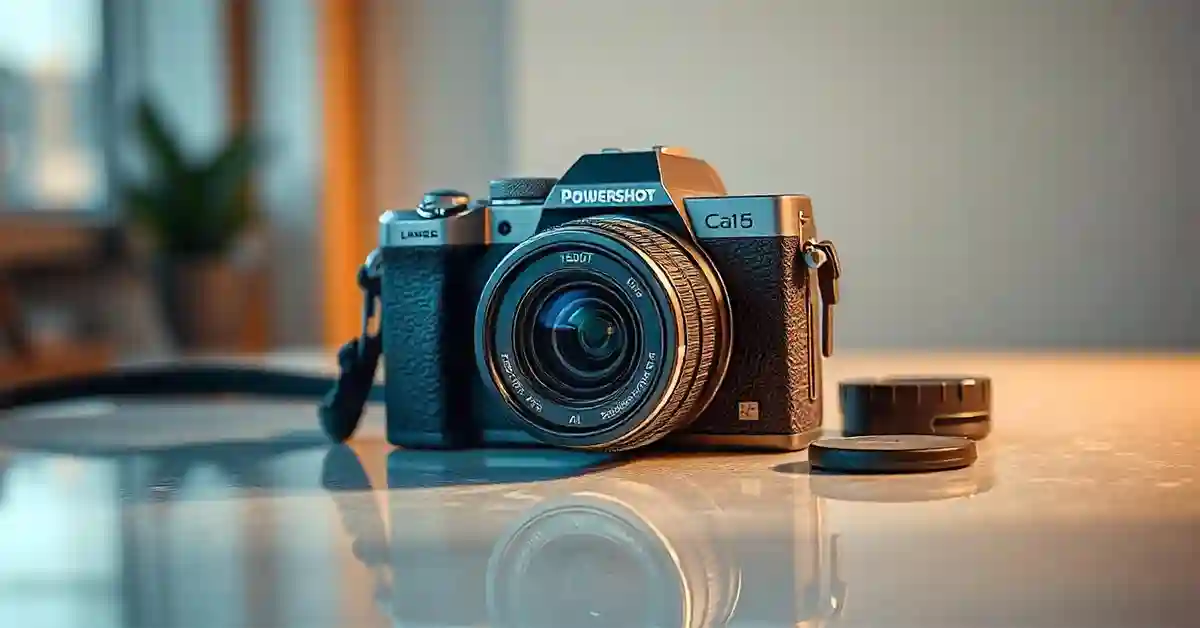
A PowerShot digital camera was the first real camera I ever owned, and Canon’s little range still charms me. It is the easy answer when a phone won’t quite do.
The line is broad, though, and a touch confusing. Let me help you place it.
I’ll cover the range, how to choose, image quality, and which model suits which person.
What a PowerShot Digital Camera Offers
So what does a PowerShot digital camera give you over a phone? Mostly proper optical zoom, a comfortable grip and controls you can actually feel under your fingers.
The range runs from pocket compacts to long-zoom bridge models. There’s a PowerShot for a coat pocket and one built for a safari.
Battery, buttons and a real shutter make it feel like a camera, not an app. For many people, that alone is the appeal.
The PowerShot Digital Camera Range Explained
The PowerShot digital camera family splits into a few clear tribes. The ELPH and IXUS compacts are pocketable, the SX bridge models chase huge zoom, and the G series courts enthusiasts.
The G series carries larger sensors and manual control. It sits closest to a serious camera, at a serious price.
Knowing the tribe shortcuts the whole decision. Pick the family first, the model second.
Choosing a PowerShot Digital Camera
Choosing a PowerShot digital camera starts with how far you actually need to zoom. Travel compacts stay slim, while the SX bridge models reach almost absurd distances.
Weigh size against reach, honestly. The more zoom you chase, the bigger the body grows in your bag.
Think about low light too. If you shoot indoors a lot, a larger-sensor G model earns its keep.
Living With a PowerShot Digital Camera
Day to day, a PowerShot digital camera is refreshingly simple to carry and use. Auto mode handles most scenes, and the menus never overwhelm a beginner.
Battery life is fair rather than heroic. I keep a spare cell in the bag for long days out.
Wi-fi on most models makes sharing painless. Snap, send to your phone, post, done.
PowerShot Digital Camera Image Quality
Image quality from a PowerShot digital camera is strong in good light, which is where most of us shoot. Colours are pleasing and the zoom pulls in detail a phone simply can’t.
The bigger-sensor G models stretch that further into dim rooms. The pocket compacts, less so.
For prints and everyday sharing, all of them deliver. Expectations just need matching to the model.
Where a PowerShot Digital Camera Falls Short
Let’s be fair: a PowerShot digital camera has real limits in low light. The small sensors struggle once the sun drops, and noise soon creeps in.
Autofocus on older compacts can hunt in the dark. A modern phone sometimes nips ahead there.
Zoom and handling remain the PowerShot’s genuine edge. Play to those and it shines.
PowerShot Digital Camera vs Your Phone
The honest question is whether a PowerShot digital camera still beats the phone in your pocket. For reach and a proper grip, yes; for sheer convenience and night shots, often not.
I carry one when zoom matters, a sports day or a wildlife walk. The rest of the time the phone tags along anyway.
It’s less either-or than people think. The two cover different jobs rather nicely.
Which PowerShot Digital Camera Should You Pick?
So which PowerShot digital camera fits you best? For pockets, the ELPH compacts; for reach, the SX bridge cameras; for quality, the G series.
To compare directly, I’ve reviewed the ELPH 360 HS and the long-zoom SX740 HS.
Rivals are worth a look too, like the Fujifilm XQ2, the Sony DSC-W830 and the Nikon Coolpix S6900.
PowerShot Digital Camera: Quick Questions
Is a PowerShot digital camera good for beginners? Very, thanks to easy auto modes and friendly menus.
Which has the best zoom? The SX bridge models reach furthest by a wide margin.
Does it beat a phone at night? Usually not, unless you step up to a larger-sensor G model.
A PowerShot taught me to love photography before I knew an f-stop from a bus stop. The range still does that job rather well.








7 thoughts on “PowerShot Digital Camera: Which Canon Compact Suits You?”